

1st Conference of the ESREA Transformative and Emancipatory Adult Education (TEAE) Network School of Humanities, Hellenic Open University, Greece 5-7 July 2023
Reimagining transformative and emancipatory adult education for a world to come
Φωτογραφίες / Pictures: https://www.flickr.com/photos/199249866@N06/albums/72177720311546386
Reimagining transformative and emancipatory adult education for a world to come
In times of crises – such as the climate crises, structural racism, social inequities, or a pandemic – there is a need to transform our taken for granted ways of knowing and being in the world, this promises an opportunity for emancipation. How can we re-imagine transformative and emancipatory adult learning to co-create a world to come? The idea of adult education (lat. educere) as a way forward, leading out from the crises we currently experience is at the heart of our TEAE network. When we experience something truly transformative, deep, fundamental change, whether it is collectively or individually, we are losing our sense of (self-)direction and our way in the world. How can we regain a sense of (self-)direction? How can we lead ourselves -individually and/or collectively – out? What are possible pathways forward?
One way forward is concerned with radical questioning. In the midst of this global crisis, searching for ways forward it is ”terrifying because it means giving up the familiar banisters and guidelines that we normally accept in orienting our lives; dangerous because, when such questioning is truly radical, it seems to leave us with nothing; liberating because it frees us from illusions and enables us to confront our subjectivity and inwardness without illusions” (Bernstein, 2016, p. 121)1. What motivates our efforts to learn in a transformative and emancipatory way? It is our quest for self-knowledge and our hope to imagine and co-create a new, more sustainable, inclusive, and just world. Facing crisis confronts us not only with the challenge but also with the possibility to learn, grow, change and at times even transform our deep structures. Starting from those questions, the conference will invite theoretical and empirical contributions that will shed new light on this topic.
1 Bernstein, R. J. (2016). Ironic Life. Polity Press.
Please find in the attached file, some useful information for your conference registration! In order to ensure a smooth planning of the conference, please follow the instructions and register as soon as possible. We look forward to meeting you at the conference!
We would like to inform you that for reasons related to our effort to comprehensively review the proposals submitted, the date of notification of their acceptance is being moved to May 15, 2023. We know that this new date is a little incovenient. However, we kindly ask for your understanding since the number of proposals was significant and beyond our expectations and this is really good news for our new network!!
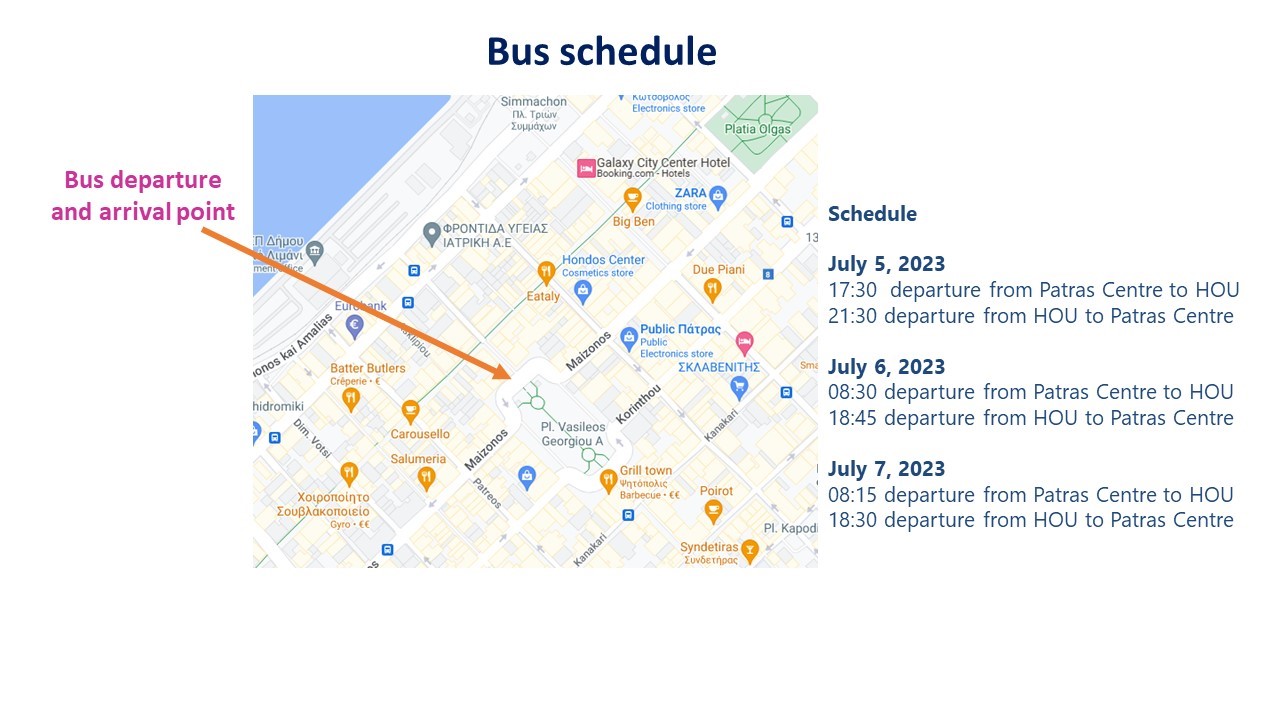
Bus schedule from Patras Centre to HOU and vice versa
Prof. José Pedro Amorim, University of Porto, Portugal,
Prof. Francesca Bracci, University of Florence, Italy,
Dr. Athina Charissi, Hellenic Open University, Greece,
Prof. Loretta Fabbri, University of Siena, Italy,
Prof. Alexis Kokkos, Hellenic Open University, Greece,
Dr. Effrosyni Kostara, Hellenic Open University, Greece,
Dr. Anna Laros, University of Applied Sciences and Arts, Northwestern Switzerland,
Prof. Licínio Lima, University of Minho, Portugal,
Prof. Aliki Nicolaides, University of Georgia, USA,
Prof. Claudio Melacarne, University of Siena, Italy,
Prof. Alberto Melo, University of Algarve, Portugal,
Dr. Marguerite Welch, St. Mary’s College, USA.
The Conference is organized by the Convenors of the TEAE network:
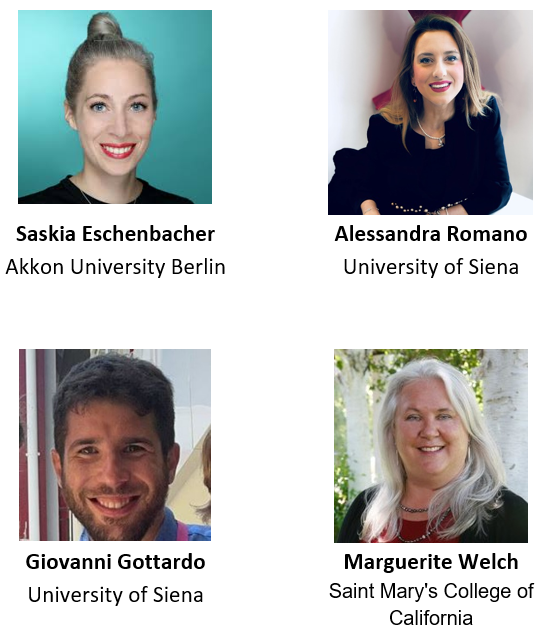
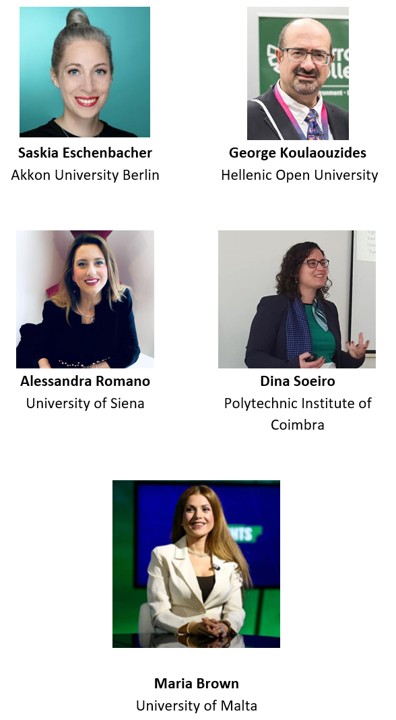
Saskia Eschenbacher, Professor, Akkon University
George Koulaouzides, Assistant Professor, Hellenic Open University
Alessandra Romano, Associate Professor, University of Siena
Dina Soeiro, Assistant Professor, Instituto Politécnico de Coimbra
With the kind and generous support of the administration and staff from various departments of the Hellenic Open University

Transformative and Emancipatory Adult Education (TEAE) Network
Research Retreat Symposium 2025
Transforming Work-Life Balances
18-20 June 2025
Venue: University of Malta, Valletta Campus
Welcome letter, Guidelines for Participants, List of Presenters
Research Retreat Theme
Transforming Work-Life Balances
How do we navigate our work-life balance? What does the way we hold work, and the way we hold life tell us about ourselves? What subjective value do we place on our jobs? One way to look at how we balance work and life is to think of it in terms of improvement and optimization. Another, deeper way to think about it is to question the distinction itself instead of optimizing it. Some scholars even argue against separating work and life altogether, viewing any divide as artificial. In academia—perhaps more than in other fields—we often conflate our identities with our jobs, the titles we hold, the positions we have earned, and the research we conduct. The questions we pursue in our work often reflect our own life experiences. In this context, the statement “I am my job” resonates strongly. Yet, it raises significant inquiries: Who are we beyond our professional roles? What constitutes our deeper sense of purpose?
We learn or don’t learn to navigate our work-life balances throughout our careers and at different times, we need to reassess this balance. What if we struggle? How can we move to a place of possibility from a place of difficulty? Every crisis offers moments of decisions to move beyond our current way of being in the world. We become aware that we are not trapped by one way of looking at the world or being in the world. Our struggle becomes a moment of emancipation. There is another, deeper layer to the question of how we can navigate our work-life balance, one that is tied to today’s struggle. Morgan Housel articulates how this relationship has evolved; historically, factory workers could visibly see the results of their labor, and upon departing the workplace, their workdays concluded. But when our job is to think – and in academia to produce impactful research, we do not detach from work once we leave the office – our days don’t end. Working in our heads, thinking through problems and research questions, feels like work never ends. We can’t just detach from our work once we leave the office because the tools, we would have to leave behind is our head – which never leaves us. Does work ever truly end? It might not always feel like that. How are we supposed to navigate and manage a sustainable work-life balance when the line that separates both is so blurry?
- What is the struggle within your current research?
- How does your work reflect your experiences?
- How does your research reflect and connect to transformation and/or emancipation?
- How do you balance your work-life balance around your research?
Research has shown that having control over our time is key to happiness and that this very control has diminished. How can professionals cultivate the capacity to rest in a perpetually demanding environment? How can we disengage from work while maintaining productivity? Furthermore, how can we effectively assimilate and reflect upon our professional experiences, allowing for growth and potential transformation?
These questions create the framework for our forthcoming TEAE network event. In the 2025 research retreat of the TEAE network we will gather in formal and informal events to examine the aforementioned fundamental questions and in an environment that promotes both scholarly exchange and time to reflect and engage. The objective is to rethink and enhance the manner in which we organize our research, our professional and personal life and foster connections within our community
Join us in our endeavor, share with us your ideas for discussion!
Let’s transform our work-life balances and our way of working together!
Transformative and Emancipatory Adult Education (TEAE) Network
Research Retreat Symposium 2025
Transforming Work-Life Balances
18-20 June 2025
Venue: University of Malta, Malta
Call for Proposals
How do we navigate our work-life balance? What does the way we hold work, and the way we hold life tell us about ourselves? What subjective value do we place on our jobs? One way to look at how we balance work and life is to think of it in terms of improvement and optimization. Another, deeper way to think about it is to question the distinction itself instead of optimizing it. Some scholars even argue against separating work and life altogether, viewing any divide as artificial. In academia—perhaps more than in other fields—we often conflate our identities with our jobs, the titles we hold, the positions we have earned, and the research we conduct. The questions we pursue in our work often reflect our own life experiences. In this context, the statement “I am my job” resonates strongly. Yet, it raises significant inquiries: Who are we beyond our professional roles? What constitutes our deeper sense of purpose?
We learn or don’t learn to navigate our work-life balances throughout our careers and at different times, we need to reassess this balance. What if we struggle? How can we move to a place of possibility from a place of difficulty? Every crisis offers moments of decisions to move beyond our current way of being in the world. We become aware that we are not trapped by one way of looking at the world or being in the world. Our struggle becomes a moment of emancipation. There is another, deeper layer to the question of how we can navigate our work-life balance, one that is tied to today’s struggle. Morgan Housel articulates how this relationship has evolved; historically, factory workers could visibly see the results of their labor, and upon departing the workplace, their workdays concluded. But when our job is to think – and in academia to produce impactful research, we do not detach from work once we leave the office – our days don’t end. Working in our heads, thinking through problems and research questions, feels like work never ends. We can’t just detach from our work once we leave the office because the tools, we would have to leave behind is our head – which never leaves us. Does work ever truly end? It might not always feel like that. How are we supposed to navigate and manage a sustainable work-life balance when the line that separates both is so blurry?
- What is the struggle within your current research?
- How does your work reflect your experiences?
- How does your research reflect and connect to transformation and/or emancipation?
- How do you balance your work-life balance around your research?
Research has shown that having control over our time is key to happiness and that this very control has diminished. How can professionals cultivate the capacity to rest in a perpetually demanding environment? How can we disengage from work while maintaining productivity? Furthermore, how can we effectively assimilate and reflect upon our professional experiences, allowing for growth and potential transformation?
These questions create the framework for our forthcoming TEAE network event. In the 2025 research retreat symposium of the TEAE network we will gather in formal and informal events to examine the aforementioned fundamental questions and in an environment that promotes both scholarly exchange and time to reflect and engage. The objective is to rethink and enhance the manner in which we organize our research, our professional and personal life and foster connections within our community
Join us in our endeavor, share with us your ideas for discussion!
Let’s transform our work-life balances and our way of working together!
Where and when
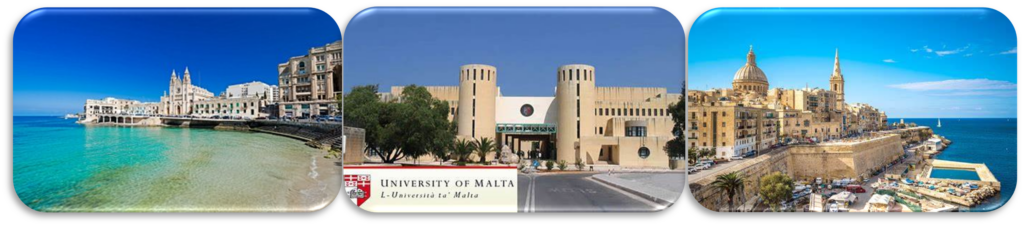
University of Malta
18-20 June, 2025
We welcome you to submit your proposal!
Saskia Eschenbacher, Akkon University Berlin
George Koulaouzides, Hellenic Open University
Alessandra Romano, University of Siena
Dina Soeiro, Instituto Politécnico de Coimbra
The conveners of the ESREA Research Network on Transformative and Emancipatory Adult Education
Proposal and paper guidelines
We welcome proposals for theoretical papers, empirical research and experiential sessions. The deadline for the submission of abstracts is January 15th, 2025. Full papers (max 2,000 words) to be submitted by May 15th, 2025.
Proposals should not exceed 500 words (without references), including title. Please submit name of the author(s) institutional affiliation and contact details on a separate page. Please submit your proposal as a word document (using APA 7 as a citation style) to the following email: teaenetwork@gmail.com
The conference language will be English and the following criteria will be used to review proposals:
- the relevance to transformative and emancipatory adult learning theory or practice;
- the relevance to the conference theme;
- the clarity of the theoretical framework; and
- the clarity of the method and implications for experiential proposals.
The proposals will be peer-reviewed by a committee composed of a panel of researchers and scholars from the field of transformative learning and adult education. Notification of acceptance will be sent by the end of March 2025.
Transformative and Emancipatory Adult Education (TEAE) Network
Research Retreat Symposium 2025
Transforming Work-Life Balances
18-20 June 2025
University of Malta, Malta
Fees:
ESREA member: 100 €
Non-member: 125 €
Postgraduate students: 75 €
Please deposit the fees to the following Bank Account
Piraeus Bank
SWIFT code = PIRBGRAAXXX.
Account Number (IBAN): GR84 0171 3190 0063 1915 1450 278
Account holder name: ELKE ELLINIKO ANOIKTO PANEPISTIMIO ΕΛΚΕ ΕΛΛΗΝΙΚΟ ΑΝΟΙΚΤΟ ΠΑΝΕΠΙΣΤΗΜΙΟ
IMPORTANT NOTE:
Please do not forget to mention in the deposit the Conference Code 80666 and your full name.
Accommodation in Valetta, Malta
The following are accommodation rates for different hotels. When booking please mention “ESREA Network Meeting/University of Malta” to apply these rates.
Osborne Hotel – 3* (within walking distance from meeting venue)
50 South Street, Valletta
Email : reservations@osbornehotel.com
Standard room for sole use @ 160E per night on bed & breakfast basis
Standard room for double use @ 175E per night on bed & breakfast basis
The Londoner Hotel – 3*
The Strand, Sliema
Email : gm@thelondonerhotels.mt
Comfort room for sole use @ 155E per night on bed & breakfast basis
Comfort room for double use @ 170E per night on bed & breakfast basis
Superior room for sole use @ 165E per night on bed & breakfast basis
Superior room for double use @ 180E per night on bed & breakfast basis
The Londoner Hotel – 3*
St George’s Road, St Julians
Email : gm@thelondonerhotels.mt
Comfort room for sole use @ 145E per night on bed & breakfast basis
Comfort room for double use @ 160E per night on bed & breakfast basis
Superior room for sole use @ 155E per night on bed & breakfast basis
IKYK Hotel – 3*
15 Wilga Street, St Julians
Email : reservations@ikcollection.com
Economy room @ 119E per night on bed & breakfast basis
Superior room @ 130E per night on bed & breakfast basis
Verdi Gzira Waterfront Hotel – 4*
113 The Strand, Gzira
Email : stay.malta.gzira@verdihotels.com
Superior inland room for sole use @ 160E per night on bed & breakfast basis
Superior inland room for double use @ 180E per night on bed & breakfast basis
Deluxe room for sole use @ 175E per night on bed & breakfast basis
Deluxe room for double use @ 195E per night on bed & breakfast basis
Verdi St George’s Bay Marina Hotel – 4*
St George’s Bay, St Julians
Email : stay.malta.marina@verdihotels.com
Superior seaview room for sole use @ 190E per night on bed & breakfast basis
Superior seaview room for double use @ 210E per night on bed & breakfast basis
Holm Boutique Hotel – 4*
Sqaq Fabri Lane, St Julians
Email : reservations@ikcollection.com
Superior room @ 150E per night on bed & breakfast basis
The Victoria Hotel – 4*
Gorg Borg Olivier Street, Sliema
Email : sylvain.azzopardi@axhotelsmaltaa.com; gabriel.cortis@axhotelsmalta.com
Classic room @ 190E per night on bed & breakfast basis
Kennedy Nova Hotel – 4*
116 The Strand, Gzira
Email : sales@kenndynova.com
Single standard room @ 86E per night on bed & breakfast basis
Double standard room @ 100E per night on bed & breakfast basis
La Falconeria Boutique Hotel – 4* (within walking distance from meeting venue)
62 Melita Street, Valletta
Email : steven@lafalconeria.com
Standard room @ 215E per night on bed & breakfast basis
Urban Valley Resort – 4*
Triq Wied Ghollieqa, San Gwann
Email : reservations@urbanvalleyresort.com
Superior room for sole use @ 180E per night on bed & breakfast basis
Suprior room for double use @ 190E per night on bed & breakfast basis
Noru Hotel – 4*
Triq Elija Zammit, St Julians
Email : gm@noruhotelmalta.com
Standard room @ 145E per night on bed & breakfast basis
Superior room @ 155E per night on bed & breakfast basis
Waterfront Hotel – 4*
Triq ix-Xatt, Sliema
Single room @ 190E per night on bed & breakfast basis
Double room @ 200E per night on bed & breakfast basis
The Saint John Boutique Hotel – 4* (within walking distance from meeting venue)
Merchants Street, Valletta
Email : sylvain.azzopardi@axhotelsmaltaa.com; gabriel.cortis@axhotelsmalta.com
Comfort room @ 240E per night on bed & breakfast basis
Hyatt Centric Hotel – 5*
Triq Santu Wistin, St Julians
Email : ruth.micallef@hyatt.com
Standard room for sole use @ 270E per night on bed & breakfast basis
Standard room for double use @290E per night on bed & breakfast basis
Corinthia Hotel – 5*
St George’s Bay, St Julians
Email : maria.camilleri@corinthia.com; jovana.jokic@corinthia.com
Superior inland room for sole use @ 204E per night on bed & breakfast basis
Superior inland room for double use @ 224E per night on bed & breakfast basis
Deluxe seaview room for sole use @ 228E per night on bed & breakfast basis
Deluxe seaview room for double use @ 248E per night on bed & breakfast basis
Radisson Blu Resort – 5*
St George’s Bay, St Julians
Email : maria.camilleri@corinthia.com; jovana.jokic@corinthia.com
Standard room for sole use @ 198E per night on bed & breakfast basis
Standard room for double use @ 218E per night on bed & breakfast basis
Superior seaview room for sole use @ 222E per night on bed & breakfast basis
Superior seaview room for double use @ 242E per night on bed & breakfast basis
The Palace Hotel – 5*
High Street, Sliema
Email : sylvain.azzopardi@axhotelsmalta.com; gabriel.cortis@axhotelsmalta.com
Comfort room @ 225E per night on bed & breakfast basis
Marriott Hotel – 5*
Main Street, St Julians
Email : Mariella.BorgBondin@maltamarriott.com
Superior room with courtyard view for sole use @ 250E per night on bed & breakfast basis
Superior room with courtyard view for double use @ 264E per night on bed & breakfast basis
Travelling to Malta by plane or by ferry
Flying to Malta
Malta International Airport
The Malta International Aiport is the only airport in the Maltese Islands and is located between Luqa and Gudja in the south. The airport lays southwest of the Maltese capital Valletta. The Customer Services Centre is located inside the check-in hall and is also open around the clock.
Flying to Malta by low-cost airlines:
- Ryanair
• Easy Jet
• Norwegian Air Shuttle
• Bmi Baby
• Vueling Airlines
Flying to Malta by standard airlines:
- Air Malta (from several European and Middle-eastern cities)
• Airberlin (from Berlin, Nuremberg and Basel)
• Alitalia (from Rome and connections to all over the world)
• Brussels airlines (from Brussels)
• Condor (from several UK cities)
• Egypt Air (from Cairo)
• Emirates (from Cyprus, Dubai, and connections to all over the world)
• Finnair (from Helsinki)
• Germanwings (from East Midlands, Bremen, Frankfurt & Hannover)
• Iberia y Air Nostrum (from a few Spanish cities)
• Libyan Airlines (from Tripoli)
• Lufthansa (from Frankfurt, Munich, and connections from all over the world)
• Luxair (from Luxembourg)
• Meridiana SpA (from several Italian cities)
• Scandinavian Airlines (from Stockholm)
• Tunisair express (from Tunis and Carthage)
• Spanair (from Barcelona and connections Bamako, Berlin and Hamburg)
• Swiss International air lines (from Zurich)
Note: Some of these routes are seasonal, and subject to change.
Getting to Malta by ferry
Malta is served by several major ferry lines. Malta can be reached by the following companies:
Grimaldi Ferries:
From Civitavecchia – 80km north of Rome and Catania in the east of Sicily
Name: Grimaldi Lines
Address: 13, Via M. Campodisola, Napoli 80133, Italy
Telephone: +39 081 496 444
Website: www.grimaldi-lines.com
Email: info@grimaldi.napoli.it
Virtu Ferries:
From Pozzallo in the south of Sicily and Catania in the east of Sicily
Name: Virtu Ferries
Address:Virtu Passenger Terminal, Xatt il-Ghassara tal-Gheneb,Marsa, Malta
Telephone: +356 22069022
Website: www.virtuferries.com
Email: res@virtuferries.com
Viamare:
From Genoa and Livorno in the North of Italy
Name: Viamare Limited
Address: Suite 3, 447 Kenton Road, Harrow, Middlesex, HA3 0XY, United Kingdom
Telephone: +44 20 8206 3420
Website: ww.viamare.com
Grandi Navi Veloci:
From Palermo in the north of Sicily, Livorno in the north of Italy
Name: Grandi Navi Veloci
Address: 17, Via Fieschi,Genoa, Italy
Telephone: +39 010 2094591
Website: www.gnv.it
Transformative and Emancipatory Adult Education
(TEAE) ESREA Network
Research Retreat 2025
Transforming Work-Life Balances
18-20 June 2025
OVERALL PROGRAM
June 18, 2025
Highlight: Get together at a rooftop bar for cocktails – 6 pm – 7 pm
(dinner in groups afterward is optional)
June 19, 2025
9:00 – 9:15 am | Arrival and Check-In |
9:15 – 9:30 am | Welcome |
9:30 – 10:00 am | Experiential Session 1 – part I |
10:00 – 11:15 am | Group Sessions |
11:15 – 11:45 am | Coffee Break |
11:45 – 12:15 am | Experiential Session 2 |
12:15 – 12:30 pm | Wrap up Day 1 |
Optional: Social Dinner & Get together
June 20, 2025
9:00 – 9:15 am | Arrival and Check-In |
9:15 – 9:35 am | Welcome and note from University of Malta |
9:35 – 9:45 am | Other greetings |
9:45 – 10:30 am | Experiential Session 3 |
10:30 – 11:00 am | Coffee Break |
11:00 – 12:15 am | Group Sessions |
12:15 – 12:45 am | Experiential Session 1 – Part II |
12:45 – 13:00 pm | Wrap up Day 2 & Goodbye |
Optional: Goodbye get together